
Cruise First Aid: Drugs, Supplements, Homeopathy

What’s What and When It Actually Works
DISCLAIMER: This article contains organized public information about over-the-counter products. It is not medical advice and is not a substitute for seeing a doctor. Always read the label and package insert before taking any medication. If symptoms are serious, getting worse, or not improving – see a doctor. Information is current as of publication date and may change.
Every day in the lab I work with data. DNA research is essentially an endless process of figuring out what works, what doesn’t, and why.
When I started traveling seriously – first cruises out of LA, then longer trips – I kept running into the same thing. Most people can’t read a pharmacy shelf. Not because they’re not smart. But because nobody ever explained the difference between a drug, a dietary supplement, and a homeopathic remedy. And the difference is significant.
I spent time working through this systematically. Here’s what I put together.
But first – where this topic actually comes from for me personally.
Why I Wrote This Article Series
I was five years old when my parents brought me to the United States from Moldova.
I barely remember it – I was too young. But I grew up watching an immigrant family navigate American medicine. It was its own process. Sometimes it is funny. Sometimes quite the opposite.
My parents didn’t trust local medications for a long time. Not because they were uneducated – my dad is an engineer, my mom is an accountant. But because of the human factor: what’s familiar from childhood feels reliable. What’s unfamiliar triggers distrust. That’s universal psychology, not a character flaw.
In the early years, they ordered medications from Ukraine. Relatives brought them over when they visited – whoever was flying in or flying back. No-Shpa, Valerian root, activated charcoal, Corvalol. Whole bags of it.
And in the other direction – American products flew back. Advil, Tylenol, Nyquil – things sold in any pharmacy here without a prescription. Relatives in Ukraine received these as something special, hard to find.
I watched this for years. The same molecules, different boxes, different directions of travel. Ibuprofen is ibuprofen – whether you buy it in Kharkiv or at the CVS on the corner. But psychologically, it felt different.
Then I went to university, started working in a lab, learned to read scientific literature. And gradually I understood that most of the confusion wasn’t about medication quality. It was about not knowing the system. Nobody had explained the difference between a drug, a supplement, and a homeopathic remedy. Nobody had explained that “over-the-counter” doesn’t mean “weak” – it’s just a different category of access.
And that a doctor will prescribe the right thing if you explain your symptoms correctly. But for that you need to know what you’re looking for and how to describe it.
I wrote this article for people who ended up in the same situation as my family. For immigrants who still don’t fully trust the American pharmacy. For people heading on a trip who want to know what to pack and why. And for anyone who just wants to understand what’s sitting on the shelf at CVS.
I’m not a doctor. I’m someone who knows how to read data and isn’t afraid to admit when he doesn’t know something.
Quick Answer
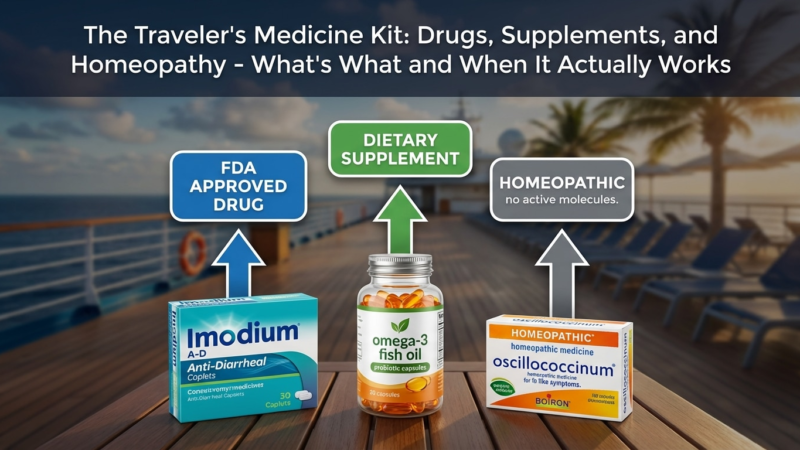
A drug – regulated by the FDA, clinically proven mechanism of action, specific dosage of active ingredient. A dietary supplement – different regulatory category, different standard of evidence, not required to prove effectiveness before going to market.
A homeopathic remedy – the active substance is diluted to the point where there are virtually no molecules of it left in the tablet.
This is important to understand before you put anything in your mouth.
Part 1: Three Categories Everyone Confuses
Drug
When you take Imodium for diarrhea or Benadryl for allergies – you’re taking a drug. The FDA regulates these products strictly:
- The manufacturer must prove effectiveness and safety before the product reaches market
- The label lists the active ingredient, its exact dosage, indications, and contraindications
- Clinical studies exist confirming that the product does what the box says
Examples of OTC drugs we’ll cover in this series: loperamide (Imodium), diphenhydramine (Benadryl), meclizine (Bonine), ibuprofen (Advil), acetaminophen (Tylenol), hydrocortisone 1% cream, and benzocaine gels (Orajel).
This doesn’t mean a drug is safe at any dose or for every person. Tylenol in overdose causes serious liver damage. Ibuprofen is contraindicated for certain stomach conditions. The package insert exists for a reason.
Dietary Supplement
Vitamins, minerals, probiotics, fish oil, ginger capsules, melatonin, magnesium – all of these are dietary supplements.
The regulation here is fundamentally different. The FDA does not review supplements for effectiveness before they go to market. The manufacturer is responsible for safety, but is not required to prove the product works as labeled. That doesn’t mean supplements are useless – some have solid evidence behind them. It means the evidentiary standard is different.
On a supplement’s label you’ll find: “These statements have not been evaluated by the Food and Drug Administration. This product is not intended to diagnose, treat, cure, or prevent any disease.” That’s not legal boilerplate – it’s an accurate description of the product’s regulatory status.
Practical takeaway: a supplement can be genuinely useful. But when you need a specific effect in a specific situation – diarrhea in Mexico, tooth pain at sea – choose a drug with a proven mechanism, not a supplement with attractive packaging.
Homeopathic Remedy
This is a separate category, and here I’ll be straightforward as a researcher.
Homeopathy is based on principles developed in the late 18th century. The central idea: a substance that causes symptoms in a healthy person – in very small doses treats those same symptoms in a sick person. And the more diluted the substance, the stronger the effect.
Homeopathic dilutions are labeled as 6C, 30C, 200C. A 30C dilution means the original substance has been diluted by a factor of 10 to the 60th power. For context – the observable universe contains roughly 10 to the 80th power atoms. At a 30C dilution, there is statistically not a single molecule of the original substance left in the tablet.
I didn’t make that up. That’s math.
Systematic reviews of clinical research – meta-analyses, the most rigorous standard of evidence in medicine – find no effects from homeopathic remedies beyond placebo. National and international medical organizations including the American Medical Association hold the same position.
But here’s what’s important to understand about placebo:
Placebo is not “nothing.” It’s a real physiological effect. In certain conditions – especially pain, nausea, anxiety – the placebo effect is documented and measurable. Some research shows that open-label placebo (where a person knows they’re taking placebo) still works in certain cases.
I’m not saying homeopathy is “cheating” people who choose it. I’m saying that if you’re taking Oscillococcinum for a cold or homeopathic drops for motion sickness – understand the mechanism. Not molecules of an active substance. The effect of expectation and the body’s own healing response.
For mild symptoms, this may be a perfectly acceptable choice. For serious ones – it’s a delay in getting real treatment.
How to recognize a homeopathic product:
- The label shows a dilution notation: 6X, 12C, 30C, etc.
- Often the word “Homeopathic” appears directly on the box
- Common brands: Boiron, Hyland’s, and some products marketed as “natural” or “traditional”
Part 2: Why This Matters for Travelers
When you’re traveling – especially on a cruise – a pharmacy isn’t always accessible. The ship’s medical center exists, but it’s paid service on a schedule. In a Mexican port, a farmacia is easy to find, but you need to know what to ask for.
When you have diarrhea in Cabo San Lucas four hours before the ship sails – you need to know what to take. Not guess.
I put this series together as a practical reference. Each article covers one problem category, breaks down the available OTC options, explains when what works, and tells you when it’s time for a doctor.
This is public information that I’ve organized. This is not a medical recommendation.
Part 3: General Rules for OTC Medicine While Traveling
A few principles that apply to any situation:
Read the active ingredient, not the brand.
Tylenol and acetaminophen are the same thing. Advil and ibuprofen are the same thing. Bonine and meclizine are the same thing. Store-brand generics with the same active ingredient work identically to branded versions and cost 2-3 times less.
Check drug interactions.
Some OTC combinations are unsafe. A classic example: many cold medications contain acetaminophen. If you’re taking Nyquil and Tylenol simultaneously – you’re double-dosing acetaminophen, which creates real liver risk. The Drugs.com app or Medscape Drug Interaction Checker lets you verify any combination for free.
Store medications correctly.
Most OTC medications require storage below 77°F (25°C). A cruise cabin in Mexico can get warmer than that with the balcony door open. Don’t leave medications in direct sun or in a hot car – it affects potency.
Expiration dates matter – but not equally for everything.
Most tablets retain about 90% of their potency for several years past expiration. Liquid formulations degrade faster. Discard eye drops and wound care products after expiration – contamination risk is real.
Children’s dosing is not a scaled-down adult dose.
Pediatric dosages are calculated by weight. Some adult medications aren’t safe for children at all – aspirin is contraindicated for children under 12 due to Reye’s syndrome risk. If you’re giving medication to a child, read the children’s label. Don’t reduce the adult dose by eye.
Part 4: When OTC Stops Working – Signs You Need a Doctor
General red flags that mean “stop self-treating and get help”:
Fever above 103°F (39.4°C) or a fever that doesn’t come down with standard doses of ibuprofen or acetaminophen within 48 hours.
Symptoms that are getting worse, not better after 48-72 hours of OTC treatment.
Diarrhea with blood – this is not a food issue, this is serious.
Chest pain, difficulty breathing, swelling of the face or throat – possible signs of a cardiac event or anaphylaxis. Immediately call emergency services.
A headache described as “the worst of my life” – possible sign of a serious neurological event.
Any symptom in a child under 2 years old – consult a pediatrician, not the internet.
Tooth pain with swelling of the cheek or neck – possible abscess, which usually doesn’t resolve without antibiotics.
On a cruise ship the medical center operates 24 hours for emergencies. The service is paid, but travel insurance covers it. Buy travel insurance before every cruise, it may save your life.
Part 5: What to Keep in a Basic Travel Kit
This is the minimum that covers most situations. Each item is covered in detail in the corresponding article in this series.
Stomach and digestion:
- Imodium (loperamide) – diarrhea
- Pepto-Bismol (bismuth subsalicylate) – upset stomach, nausea
- Tums or Pepcid OTC – heartburn and acid reflux
- Gas-X (simethicone) – bloating and gas
Pain and fever:
- Ibuprofen (Advil/Motrin) – pain, inflammation, fever
- Acetaminophen (Tylenol) – pain, fever (alternative when ibuprofen is contraindicated)
- Naproxen (Aleve) – muscle pain, longer-lasting
Allergy:
- Loratadine (Claritin) or Cetirizine (Zyrtec) – non-drowsy
- Diphenhydramine (Benadryl) – stronger, causes drowsiness, good for nighttime
Motion sickness:
- Dramamine – Most versatile motion sickness medicine that is OTC, does cause drowsiness
- Meclizine (Bonine) – take prophylactically, less drowsy than Dramamine
- Sea-Bands – acupressure wristbands, supplement category, no side effects
Skin and wounds:
- Neosporin or Bacitracin – antibiotic ointment for cuts and scrapes
- Hydrocortisone 1% cream – itching, rash, insect bites
- Solarcaine or aloe vera gel – sunburn relief
- Compeed blister cushions – blisters from walking
Teeth:
- Orajel Maximum Strength – topical pain relief gel
- Dentemp One-Step – temporary filling material
Cold symptoms:
- Mucinex (guaifenesin) – loosens mucus
- Sudafed (pseudoephedrine) – decongestant, sold from behind the pharmacy counter with ID
- Cepacol throat lozenges – sore throat
Series Navigation
Each article below covers one category in depth – mechanism of action, specific products, dosages, when it works and when it doesn’t:
- Stomach and digestion: diarrhea, heartburn, nausea, bloating
- Tooth pain away from home: temporary fillings and numbing gels
- Headache and fever: ibuprofen vs acetaminophen vs aspirin
- Allergies: antihistamines, nasal sprays, eye drops explained
- Motion sickness: every OTC option compared
- Cuts, burns, and blisters: a practical wound care guide
- Eyes and ears: what OTC can and cannot do
- Skin problems: sunburn, rash, itching, and fungal infections
- Cold symptoms: decongestants, cough suppressants, and what actually works
- Muscles and joints: when you’ve overdone it
What to Order Right Now
If you’re heading on a cruise in the next few weeks and want to be prepared – here’s a minimal Amazon basket that covers most situations:
- Imodium Multi-Symptom Relief – diarrhea and cramps
- Pepto-Bismol Chewable Tablets – convenient for travel
- Bonine (meclizine 25mg) – motion sickness
- Sea-Band wristbands – no side effects, safe for everyone
- Advil Dual Action – ibuprofen + acetaminophen combined
- Benadryl Allergy Ultratabs – nighttime allergy and itching
- Zyrtec – daytime allergy without drowsiness
- Neosporin Original – minor cuts and scrapes
- Hydrocortisone cream 1% – itching, bites, irritation
- Orajel Maximum Strength – tooth pain
- Dentemp One-Step – temporary filling
- Compeed Blister Cushions – walking blisters
- Mucinex 12-Hour – congestion and cough
- Digital thermometer – basic diagnostic tool
This is not brand advertising. These are specific products with proven active ingredients that I’ve researched and that are available on Amazon.
A Few Final Words
My parents still occasionally ask relatives to bring something from Ukraine. I don’t argue – it’s their choice and their comfort. But now they know that the same active ingredient is available five minutes from home. Sometimes that knowledge alone takes away half the anxiety.
That’s exactly why I wrote this article. Not to say “American is better” or “Ukrainian is worse.” But to explain what’s what, how it works, and where to find it.
Everything in this series is public information. Package inserts, FDA data, clinical research findings. I organized it into a useful format for travelers and anyone else who wants to understand what’s on the shelf at CVS.
If something is serious – see a doctor. That’s not a legal formality. It’s real advice from someone who knows the difference between what a drugstore tablet can solve and what it can’t.
If you have questions about a specific situation or want me to look into a particular product in more detail – leave it in the comments. I try to answer specific questions with specific answers.
Related articles in this series:
- Stomach problems on the road: what’s available OTC and when to take what – [link]
- Tooth pain away from home: temporary fixes that buy you time – [link]
- Motion sickness: every option from Bonine to wristbands – [link]
Last updated: April 2026
DISCLAIMER: The information in this article and throughout this series is educational in nature and based on public sources. It is not medical advice. Always read the label and package insert of any product you take. For serious, worsening, or unusual symptoms, see a doctor. The author is not responsible for decisions made based on this information.



Comments are closed.