
Disembarkation Day In Los Angeles: Don’t Miss Your Flight Home

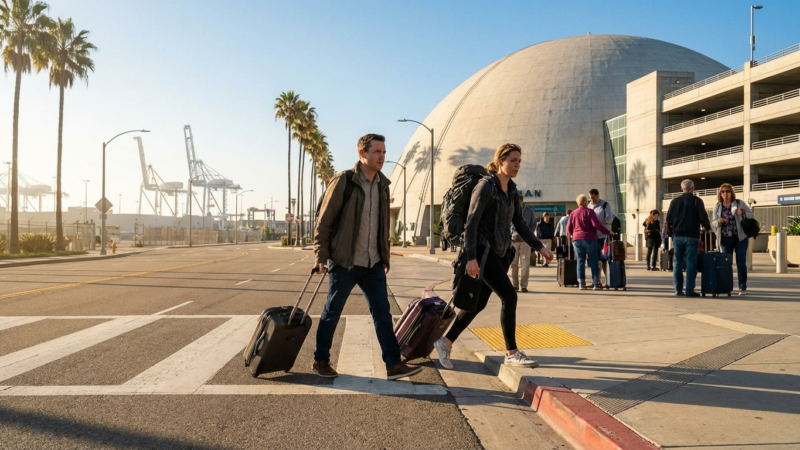
I live in North California, and when I cruise out of Long Beach on Carnival, I usually have two choices: drive the six-plus hours down and back, or fly into one of the LA-area airports and deal with a same-day flight home. Over the years, I have done both more times than I can count. Onboard I talk a lot with other cruisers too – folks from Phoenix, Las Vegas, Seattle, Detroit and everywhere else. The details are different, but one theme is always the same: disembarkation day and flights out of Los Angeles can be stressful if you get the timing wrong.
This guide is about one specific situation: Carnival cruises that arrive back to the Long Beach Cruise Terminal. Not Princess out of San Pedro, not Royal, just Carnival in Long Beach. If you are flying home the same day your ship returns, this is how I think about it, how I plan it, and what I tell people when we start talking flights over coffee on the last sea day.
What Actually Happens On Disembarkation Morning
Carnival uses a pretty standard pattern in Long Beach. The exact times move a little from cruise to cruise, but the order is usually the same.
Two Ways Off The Ship
Self-assist (Express Walk-off)
- You keep all your bags with you and carry everything off yourself.
- You pick self-assist in the Carnival app and choose a rough time window.
- No luggage tags, no hunting for bags in the terminal.
If you have a morning or even early afternoon flight, this is almost always the right choice. Skipping the luggage hall can easily save 20 to 40 minutes.
Standard disembarkation (Checked luggage)
- You put tagged bags outside your cabin the night before.
- Crew collects them and they show up in the terminal in color or number zones.
- Your group is called later, you find your bags in the hall, then head to customs.
This is fine if your flight is later in the day or you are driving home. With an early flight it adds stress you do not need.
Typical Timeline For Carnival Long Beach
- Ship docks: usually around 7:00 to 8:00 a.m. on Mexican Riviera or Baja runs.
- Ship cleared by CBP: often 30 to 60 minutes after docking.
- First self-assist groups: on a good day, roughly 7:30 to 8:15 a.m.
- Main wave of standard luggage groups: roughly 9:00 to 10:30 a.m.
- Final calls and last guests off: usually somewhere between 10:30 and 11:15 a.m.
On a smooth Sunday, early self-assist people can be standing at the curb around 8:00 to 8:30 a.m. On a rough day – slow clearance, longer itinerary like Hawaii, or light CBP staffing – everything shifts later.
From Ship To Airport: How Long It Really Takes
Once you are off the ship, you still have two more steps: the terminal and the drive.
Terminal Time: Gangway To Curb
- Very early self-assist on a good day: about 20 to 30 minutes from gangway to curb.
- Main mid-morning wave: more like 30 to 50 minutes, depending on CBP lines and luggage crowds.
- Bad day or longer itineraries: for some people it can stretch to 60 to 90 minutes total inside the terminal.
Also keep in mind: the road out of the terminal and the parking garage can back up. I have heard plenty of stories of people burning 15 to 30 minutes just trying to get out of the port area.
Drive Times From Long Beach Cruise Terminal
These are realistic ranges, not guarantees:
- To LGB (Long Beach Airport, about 11 to 13 miles):
Light traffic: 20 to 30 minutes.
Typical late morning: 25 to 40 minutes.
Bad day: 40 to 60 minutes. - To LAX (about 22 to 24 miles):
Light traffic: 30 to 45 minutes.
Typical late morning: 45 to 70 minutes.
Bad day: 70 to 100+ minutes. - To SNA / John Wayne (about 30 to 35 miles):
Light traffic: 30 to 45 minutes.
Typical late morning: 45 to 70 minutes.
Bad day: 70 to 100+ minutes.
Flight Times: Aggressive, Realistic, And Low-stress
Here is how I personally think about departure times when I am planning flights after Carnival Long Beach.
| Airport | Aggressive / risky | Realistic minimum | Low-stress target |
|---|---|---|---|
| LGB | 10:00 to 11:00 a.m. – only if you like gambling | About 11:30 a.m. to 12:30 p.m. | 1:00 p.m. or later |
| LAX | Around 11:00 a.m. – I do not recommend it | Roughly 12:00 to 1:00 p.m. | 2:00 p.m. or later |
| SNA | Around 11:00 a.m. – distance makes it tight | Around 12:00 to 1:00 p.m. | 1:30 to 3:00 p.m. |
If my only option is an 11:00 a.m. LAX flight on a busy Sunday, I am usually looking for a different flight or staying one more night. The price of a hotel and a later flight is cheaper than a missed connection and a day of stress.
My Personal Rules For Disembarkation Day
Over time I have boiled this down to a few simple rules I follow for myself:
- If my flight is before early afternoon, I always choose self-assist.
- For LAX, I try not to book anything earlier than 2:00 p.m. if I can help it.
- For LGB, I am happy with early afternoon, but I still like at least a 3 hour buffer from when I expect to step off the ship.
- If the only thing available is a very early flight, I seriously consider flying out the next day instead.
- I start disembarkation day assuming that something will run late – CBP, traffic, rideshare, whatever. I plan my schedule around that, not around a perfect day.
When You Probably Should Not Fly Home The Same Day
There are a few specific situations where I do not even try to fly home on disembarkation day, or I only do it with a late afternoon or evening flight:
- Hawaii, Panama Canal, or other long special itineraries. These can take longer to clear, and there are a lot more moving parts.
- Holiday or peak travel weekends. Think Christmas to New Year, Thanksgiving, spring break. Everything is busier: CBP, roads, airports.
- Big time zone changes and kids. If you have small children and a long flight with connections, throwing an early same-day flight on top of disembarkation can turn the day into a grind.
- When the only options are very early flights. If all you can get is 9:30 or 10:00 a.m. out of LAX, I personally would rather spend the day on the ground and fly the next morning.
In these cases I would rather build in one extra night and travel rested, instead of running a marathon on the last day of the trip.
Real-world Examples I See Again And Again
“We Made An 11:00 LAX Flight – But It Was Tight”
This one usually sounds like this: early self-assist, off the ship around 7:50, 15 minutes through CBP, Uber waiting right away, light traffic, at LAX by 9:15. They make the 11:00 a.m. flight. Then they add: “If anything had gone wrong, we would have missed it.” That is the key detail.
“Hawaii Return, Late Clearance, Long Lines”
Different cruise, same story. Ship docks on time, but CBP clearance takes longer than expected. Self-assist does not start until after 8:30. Luggage hall and CBP both packed. People with 11:00 and 11:30 flights are doing math in their heads and refreshing their airline app every 30 seconds. Some make it, some do not. The itinerary made everything slower.
“Terminal And Freeway Combo”
Embarkation itself goes fine. Off the ship by 8:45, through CBP by 9:15. Then they hit a wall: long lines to exit the parking garage, rideshare backed up, then an accident on the 405. They still make a 1:00 p.m. flight, but it is way closer than they expected when they looked at the map before the cruise.
When I talk with cruisers from Arizona, Nevada, Washington, Michigan and other states, the pattern is the same. Early flights only work when a lot of things go right at the same time. When one or two pieces slip, it quickly turns into a sprint.
Practical Ways To Reduce Stress
1. Pick The Right Disembarkation Option
If your flight is before early afternoon, choose self-assist. No checked bags. No hunting for luggage. You control your exit.
2. Be Ready Before Your Group Is Called
I like to be packed up, out of the cabin, and somewhere near my assigned waiting area before the first announcements start. I am not blocking stairwells, but I am also not still in the buffet finishing breakfast when my group is already halfway off the ship.
3. Order Your Ride Quickly
If I am using Uber or Lyft, I start watching the app while I am in the terminal. Once I am through CBP and know I am heading outside, I request the ride right away. Waiting until you are at the curb with everyone else means you get the worst of the surge and the longest waits.
4. Build A Real Buffer
My rule of thumb: from the time I expect to step onto the pier to the time the plane leaves, I want at least:
- 3 hours for LGB.
- 4 hours or more for LAX and SNA.
Some days you will not need that much. The point is you cannot predict the bad days.
5. Be Honest About Your Risk Tolerance
If the idea of sprinting through LAX with your carry-on and kids at your heels sounds like a nightmare, do not build a schedule where that is even on the table. Pick a later flight or add a night and let disembarkation day be calm.
Disembarkation Day To-do Checklist
The Night Before
- Decide: self-assist or checked luggage. With any morning flight, choose self-assist.
- If checking bags, attach tags and place them outside your cabin on time.
- Check your flight status and complete online check-in if available.
- Confirm your ground transport plan: shuttle, rideshare, taxi, or rental car.
- Set at least one alarm. Do not rely on waking up naturally.
- Lay out clothes for the morning and pack your carry-on with essentials.
- Charge your phone and power bank overnight.
Morning Of Disembarkation
- Get up early enough to eat, get ready, and be out of the cabin on time.
- Double-check the cabin: safe, drawers, closet, bathroom, balcony.
- Keep passport or ID, cruise card, phone, and wallet on your person.
- Head toward your assigned waiting area before your group is called.
- Listen for announcements and move promptly when it is your turn.
After You Leave The Ship
- If you checked luggage, go straight to your tag color or number zone and grab your bags.
- Have documents ready for CBP. Follow the lines and keep moving.
- Once clear of CBP, request your rideshare or head to your pre-booked transport immediately.
- Watch traffic in your map app on the way to the airport. If there are two reasonable routes and one is red, take the other.
- At the airport, do not waste time in the lobby. Check in, clear security, then relax at the gate.
What To Pack In Your Carry-on On Disembarkation Day
Documents And Essentials
- Passport or government-issued ID
- Boarding pass (printed or on your phone)
- Wallet with cash and cards
- Prescription medications for at least 24 hours
- Any medical devices or critical health items
Electronics
- Phone
- Charging cable
- Portable power bank
- Headphones or earbuds
Clothing And Comfort
- Change of clothes in case checked luggage is delayed
- Light jacket or hoodie
- Comfortable shoes you can move fast in if you have to
Backup Items
- Simple snacks like nuts or a granola bar
- Printed flight and transport confirmations
- Phone numbers for airline, shuttle company, or hotel
Disembarkation day in Los Angeles does not have to be chaos. If you build a real buffer, choose self-assist when you need it, and respect LA traffic for what it is, you can walk off the ship relaxed instead of sprinting toward a gate. Future you will be glad you planned it that way.



Comments are closed.